
Journal
Lighting in layers
4 September 2026 · 5 min read
By Claire Wickstead, Interior Designer
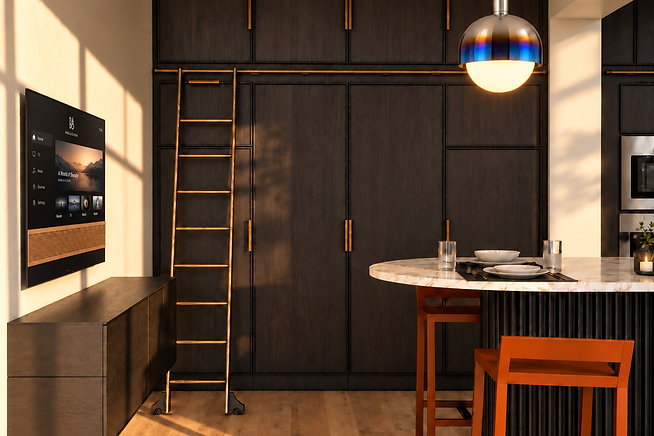
Ask someone to picture a well-lit room and they will describe brightness. Ask them to picture a room they never wanted to leave, and the light is always low, warm, and coming from somewhere other than the ceiling. The difference between the two is layering.
We design light in three layers. The first is ambient: the general wash that lets you move through a room safely, usually a combination of discreet ceiling spots and light bounced off pale surfaces. The second is task: the light you work by, focused exactly where the work happens — over an island, beside a reading chair, above a mirror. The third, and the one most homes skip, is accent: light that exists purely to give a room depth, picking out a picture, a shelf, or the texture of a wall.
Warm, low, and dimmable
Two rules do most of the work. Keep the colour temperature warm — 2700K and below in living spaces, so the light reads as candlelight rather than clinic. And make everything dimmable, so the same room can carry a busy morning and a slow evening. If a circuit can't dim, it will only ever be right for part of the day.
Then think in shadows as much as in light. A room lit evenly from above has no modelling: every surface is equally bright, so the eye finds no rest and no interest. A room with pools of light and dark corners between them feels composed, and more importantly, it feels like somewhere to sit down.
The test we use is simple: at night, with every light on, you should be able to walk through the house and find a lit reason to stop in every room — a chair, a picture, a table set for tomorrow. If the only lit thing is the middle of the floor, the layers aren't in yet.